The end of summer is the perfect time to prepare your swimming pool for the colder months. Winterising your pool properly not only helps to keep the water in good condition throughout the winter, but also reduces maintenance and makes it easier to get the pool ready when the swimming season returns.
In this guide, you’ll find step-by-step instructions on how to winterise your swimming pool, the best time to do it, which products to use and the most common mistakes to avoid.
What is pool winterisation and why is it important?
Pool winterisation is the set of maintenance tasks carried out at the end of the swimming season to protect the pool during the winter. The aim is to keep the water clean, prevent the growth of algae and microorganisms, protect the pool lining and filtration equipment, and save time, water and chemicals in the spring.
Winterising correctly offers a number of advantages:
- Prevents the water from going off during the colder months.
- It reduces the growth of algae and the appearance of stains on the walls and bottom.
- It protects the treatment plant, the filter and other components of the filtration system.
- It makes it easier to open the swimming pool in spring, whilst using less treatment products.
When should you winterise your swimming pool?
The best time to start the process is when the water temperature remains consistently below 15 °C. At this temperature, the activity of algae and bacteria decreases, making winterising products more effective.
In Spain, it usually coincides with:
Zone | Recommended moment |
Mediterranean coast | Late September to November. |
Peninsular Centre | October. |
Northern Spain | September or October, depending on the weather. |
Tip: don’t wait until the first frosts arrive to start the treatment.
A step-by-step guide to winterising your swimming pool
Step 1. Clean the swimming pool thoroughly
Before adding any product, remove all accumulated dirt.
Important:
- Vacuum the bottom of the swimming pool.
- Scrub the walls, waterline and steps.
- Empty the skimmer baskets and the pump’s pre-filter.
- Remove leaves, insects and other debris.
The cleaner the pool is, the more effective the winter treatment will be.
Step 2. Adjust the water balance
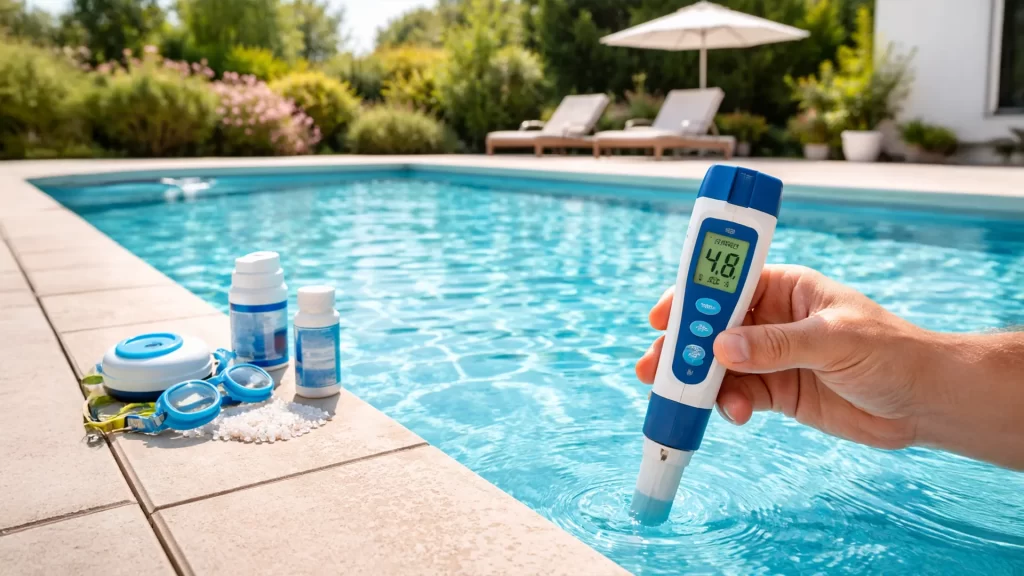
The water must be properly balanced before adding the winterising agent.
Parameter | Recommended value |
pH | 7,2 – 7,6 |
Alkalinity | 80 – 120 ppm |
Free chlorine | 1 – 3 ppm |
If any of these values are incorrect, please correct them before continuing.
See chemical balance regulators
Step 3. Carry out an intensive treatment
Before winterising, it is advisable to disinfect the water to remove any microorganisms present.
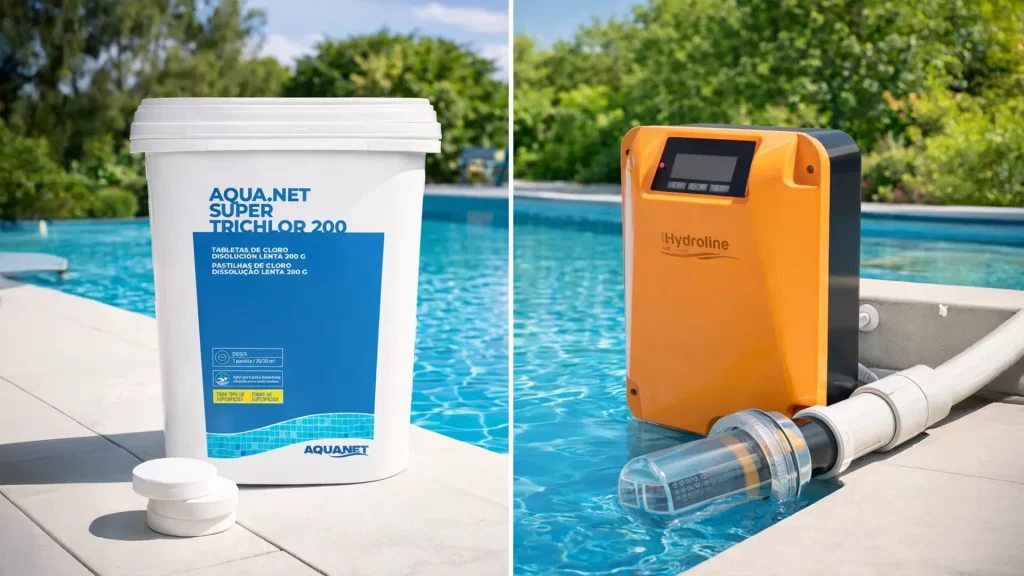
Depending on the usual treatment regime for the swimming pool, this can be carried out using:
- Active oxygen.
- Other systems that are compatible with your usual treatment.
Leave the water treatment plant running for between 8 and 12 hours after treatment.
Step 4. Add the winterising product
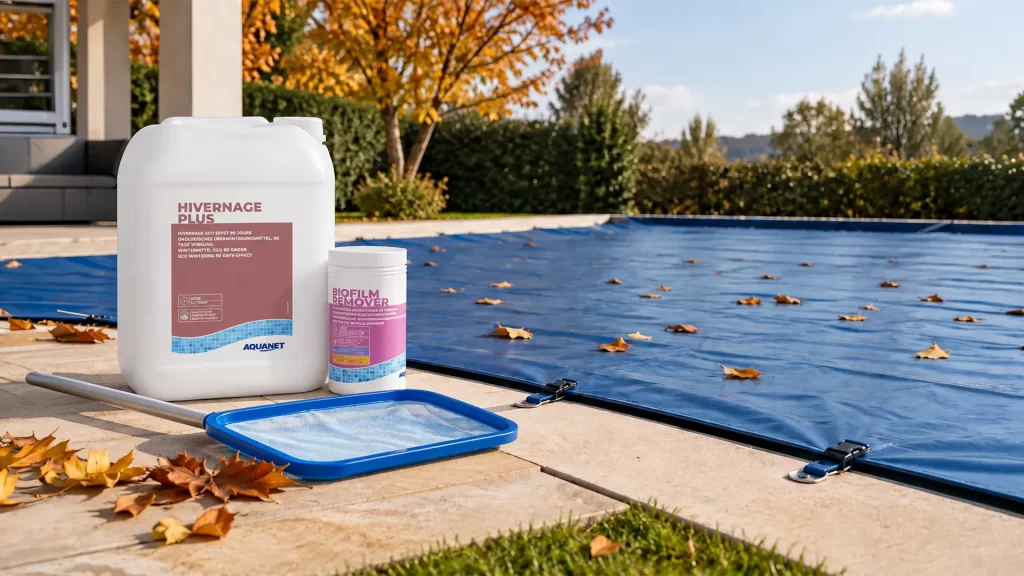
A pool winteriser helps to keep the water stable for several months.
Its main functions are:
- Prevent the growth of algae.
- To reduce limescale build-up.
- Keep the water clearer during the winter.
Add the dose specified by the manufacturer, spreading the product around the perimeter of the pool whilst the filter is running.
Step 5. Filter the water properly
After adding the treatment:
- Keep the filtration running for between 6 and 8 hours.
- If you’re using a timer, divide the time into several cycles.
During the winter, it will be sufficient to run the filter for a few hours a day (depending on the temperature and how much it is used).
Step 6. Lower the water level (only if necessary)
Not all swimming pools need to have their water drained.
Type of swimming pool | What to do |
Swimming pool with a winter cover | Maintain the usual level. |
Areas at risk of frost | Lower the water level below the skimmers. |
Portable swimming pools | Follow the manufacturer’s recommendations. |
Step 7. Protect the pool during the winter with a cover
A winter cover provides extra protection:
- Prevents leaves and dirt from getting in.
- It reduces evaporation.
- It limits sunlight, making it harder for algae to grow.
- It protects against rain and changes in temperature.
It is one of the most highly recommended ways to protect your swimming pool during the winter.
How to protect the treatment plant and the filtration system
As well as water, the equipment needs to be prepared too.
Sand filter
- Wash and rinse your car before winter.
- Check the filter pressure.
Bomb
- Clean the pre-filter.
- If there is a risk of freezing, empty the water from inside.
Pipes
- Drain the water from installations exposed to frost.
- Close the valves when necessary.
This maintenance extends the service life of the system.
Common mistakes when winterising a swimming pool
Avoid these common mistakes:
- Failing to clean the surface beforehand: dirt encourages the growth of algae and the formation of stains.
- Do not adjust the pH: the winter treatment loses its effectiveness if the water is out of balance.
- Add the winterising agent whilst the treatment plant is switched off: the product will not be distributed correctly.
- Leaving the swimming pool completely neglected: a monthly check prevents most problems.
- Draining the entire swimming pool unnecessarily: this can damage the structure and results in an unnecessary waste of water.
How do you prepare your swimming pool for spring after winterising it?
When the new season arrives:
- Remove the cover and clean it.
- Check the water level.
- Adjusts pH and alkalinity.
- Have an intensive treatment.
- Leave the water to filter for several hours.
- Clean the bottom and walls if necessary.
If the winterisation has been carried out correctly, the water will be restored much more quickly.